Welding en Español: A Practical Guide to Spanish Weld Terms
Table of Contents
- How Spanish Names the Welding Processes You Use Every Day
- Positions and Joint Types in Spanish Shop Language
- Weld and Defect Terms That Decide Acceptance
- Equipment and Positioning Vocabulary for Fabrication Teams
- Cutting and Edge Preparation Terms in Spanish
- Where Regional Spanish Changes the Instruction
- Building a Bilingual Glossary Your Fabricators Will Follow
- Send Your Weld Details and We Will Match the Equipment
- FAQ
- What is welding called in Spanish?
- Is TIG welding called something different in Spanish?
- Which Spanish terms cause the most confusion in fabrication?
- Do Spanish-speaking welders use the same position codes?
- How should Spanish terminology be handled in a WPS or drawing package?
Welding en español rarely fails for lack of vocabulary. It fails when two words look interchangeable and are not. A drawing calls the defect socavación, the inspection report calls it mordedura, and the repair note is written against a third term nobody defined. What follows is less a language problem than a document control problem, and it surfaces as rework, rejected welds, or a fabricator following an instruction that described a different operation. This guide collects the Spanish terms used for processes, positions, joints, defects, equipment and edge preparation, marks where regional usage diverges, and shows how to fix one term per concept so the buyer and the shop read the same requirement.
How Spanish Names the Welding Processes You Use Every Day
Spanish welding vocabulary runs on two layers. The formal name is long and descriptive, close to the wording used in standards and procedure documents. The shop name is short, and it is often an English loanword absorbed into everyday speech. Both are correct in their place. Trouble starts when someone translates the formal name back into a shop name, because the shop name is usually the less specific of the two.
| Process | Formal Spanish name | What shops often say | Note for documents |
|---|---|---|---|
| SMAW | Soldadura por arco con electrodo metálico revestido | soldadura con electrodo, electrodo revestido | The electrode classification identifies the consumable; the word electrodo alone does not |
| GMAW | Soldadura por arco con alambre sólido y gas protector | soldadura MIG, MIG MAG, alambre continuo | MIG and MAG are both used, so record the shielding gas |
| FCAW | Soldadura por arco con alambre tubular | hilo tubular, alambre con fundente | Never render this as soldadura MIG; the flux core changes the procedure |
| GTAW | Soldadura por arco con electrodo de tungsteno y gas protector | TIG, soldadura de argón | Soldadura de argón is common in Latin America and hides whether the gas is pure argon or a mixture |
| SAW | Soldadura por arco sumergido | arco sumergido | The flux layer is part of the process, not an accessory |
| OAW | Soldadura oxiacetilénica | soldadura autógena, soplete | Autógena is widely used for gas welding and does not state the fuel gas |
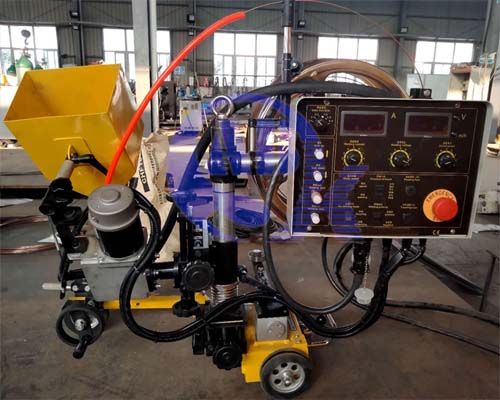
The mechanism behind these names is worth stating plainly. A process name in a procedure document stands for a set of variables: filler form, shielding medium, polarity and equipment. FCAW and GMAW share a wire feeder and look similar at the nozzle, but the flux core changes the shielding system, produces slag, and alters what the procedure qualification covers. A translation that turns soldadura por arco con alambre tubular into soldadura MIG does not simplify a sentence. It describes a different procedure, and the welder who follows it may produce a weld that no qualified procedure supports.
Submerged arc welding shows why the formal name deserves to survive translation. Soldadura por arco sumergido is almost literal, and the word sumergido carries the operating principle: the arc burns beneath a layer of fundente (flux), so the operator cannot watch the pool directly. Procedure control therefore carries more of the quality burden than operator observation, and the Spanish term keeps that fact visible where a shortened shop name would not.
Positions and Joint Types in Spanish Shop Language
Position codes travel well. A 3G qualification in Spain, Mexico or Argentina refers to the same vertical groove configuration, and the code is usually legible on a drawing even to a reader who shares no other language with the welder. The words around the code are where ambiguity enters.
| Code | English name | Spanish name in common use | Detail that must be stated |
|---|---|---|---|
| 1G / 1F | Flat | posición plana | Plate or pipe, groove or fillet |
| 2G / 2F | Horizontal | posición horizontal | Whether the axis refers to the pipe or to the plate |
| 3G / 3F | Vertical | posición vertical | Ascendente (uphill) or descendente (downhill) |
| 4G / 4F | Overhead | posición sobre cabeza | Access and support conditions |
| 5G | Pipe fixed horizontally | tubo fijo horizontal | Welding progresses around a pipe that does not rotate |
| 6G | Pipe inclined at 45 degrees | tubo inclinado a 45 grados | The test position used for pipe welders |
Joint names follow the same pattern of literal description. A butt joint is a junta a tope, a T joint is a junta en T, a lap joint is a junta de solape or junta traslapada depending on the country, a corner joint is a junta de esquina, and an edge joint is a junta de borde. A fillet weld is a soldadura de filete, while groove welds are described formally as soldadura de ranura, although many shops simply say soldadura a tope.
The qualification consequence is concrete. In most qualification schemes, vertical uphill and vertical downhill welding are treated as separate conditions, so a record that says only posición vertical leaves the reader unable to confirm coverage. The same applies to pipe positions: a welder qualified on a rotating pipe is not automatically qualified for a fixed pipe welded overhead. Ask for the code, the Spanish name and the progression direction in the same line, and the ambiguity disappears.
Weld and Defect Terms That Decide Acceptance
Defect vocabulary is where terminology turns into money. The physical features are stable, but the words vary by country and by inspector, and an acceptance decision written in one word can be executed against another.
| Feature | Spanish term | Variants you will meet | Why the wording matters |
|---|---|---|---|
| Porosity | porosidad | poros, porosidad superficial | Limits are set by size and count over a length, not by the noun |
| Undercut | socavación | mordedura (common in Mexico), socavado | The repair instruction should repeat the term used in the inspection report |
| Crack | grieta | fisura, usually for a fine crack | Acceptance depends on length, location and orientation, not on the adjective |
| Lack of fusion | falta de fusión | no fusión | Often invisible from the surface, so the term should trigger a method check |
| Lack of penetration | falta de penetración | penetración incompleta | Requires root side or volumetric examination to confirm |
| Slag inclusion | inclusión de escoria | escoria atrapada, inclusión de fundente in SAW | In submerged arc welding the trapped material is flux, and the term should say so |
Two supporting terms appear in almost every report and are worth fixing early. The heat affected zone is the zona afectada por el calor, usually shortened to ZAC, and the individual runs in a weld are pases: pase de raíz for the root, pase de relleno for fill passes, and pase de presentación or pase de acabado for the capping pass. A discussion about a weld that failed twice often turns out to be a discussion about which pass failed, so the pass vocabulary matters as much as the defect vocabulary.
Honesty about method is part of this section. Visual inspection, inspección visual, can identify undercut, surface porosity and crater shape, but it cannot confirm lack of fusion or lack of penetration inside a joint. Those require ultrasonido, radiografía industrial or another volumetric method agreed in the inspection plan. A document that lists falta de fusión as a visual finding has a method problem, whatever language it is written in.
Distortion deserves its own entry because it drives correction work. Distorsión and deformación are both used, and the correction step is enderezado. Straightening after welding redistributes residual stress rather than removing it, so the acceptance criteria for the corrected part and the method used to correct it belong in the same procedure review.
Equipment and Positioning Vocabulary for Fabrication Teams
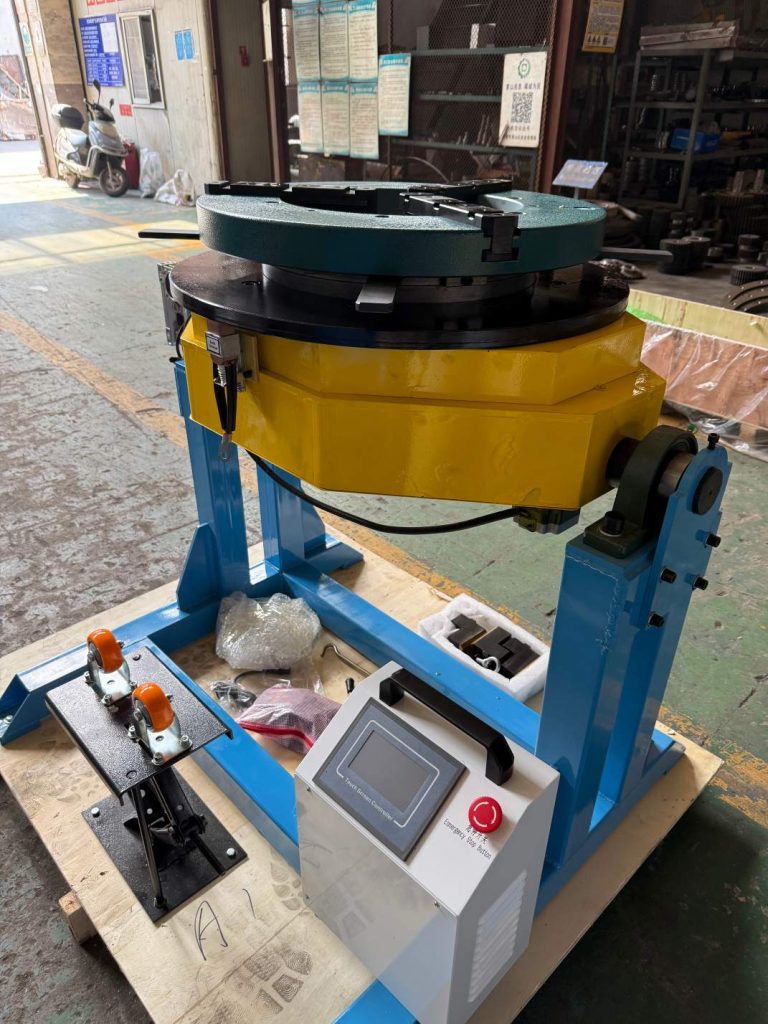
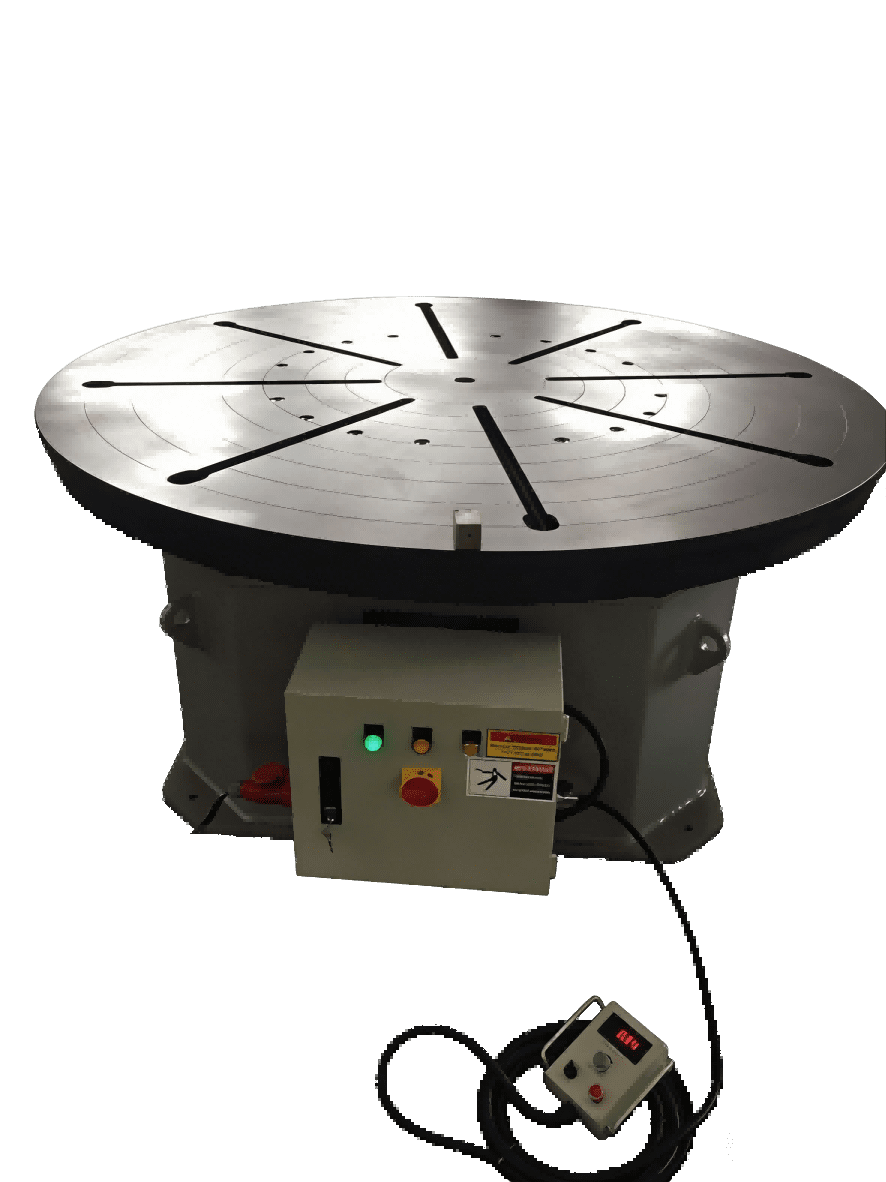
Equipment nouns cause more quotation errors than process nouns, because machine categories overlap in function and the words differ by country. A posicionador de soldadura holds a workpiece on a table that rotates, tilts or does both, and the workpiece is normally clamped. A rotador de soldadura, also called a volteador, turns a cylindrical workpiece about its own axis on driven and idler rollers while the workpiece stays at floor level. A mesa giratoria or plato giratorio is the turntable form, and cabezal y contrapunto describes a headstock and tailstock arrangement for long workpieces held at both ends.
Bilingual teams often meet the fixed and adjustable positioner categories in a quotation before they meet them on the floor. <Fixed vs Adjustable Welding Positioners: How to Choose the Right Tool> covers how the two designs differ in setup and workpiece handling.
Function is the safer specification than the noun. In Mexico a volteador usually means the machine that rotates cylindrical work, while in Spain the same word has been applied to a tilter, which changes the load path and the foundation requirement. A buyer who names only the word may receive a different machine category. A buyer who states the function, the load, the diameter range and whether the workpiece must rotate, tilt or rise, gives the supplier something testable.
Roller-based equipment carries its own vocabulary of conventional, adjustable and self-aligning designs, and the differences affect which diameters a machine can hold. <Industrial Welding Rotator Types & Structural Designs> covers those structural designs.
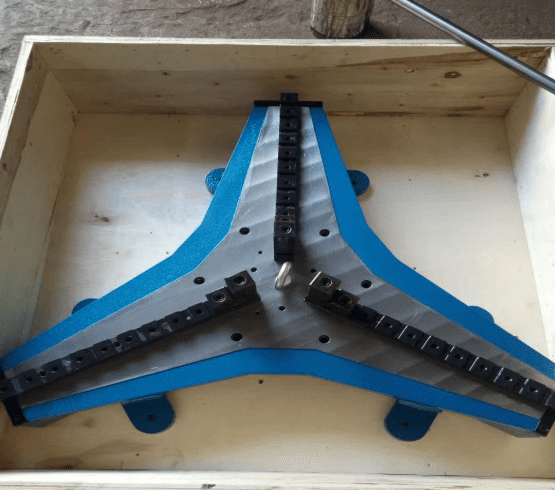
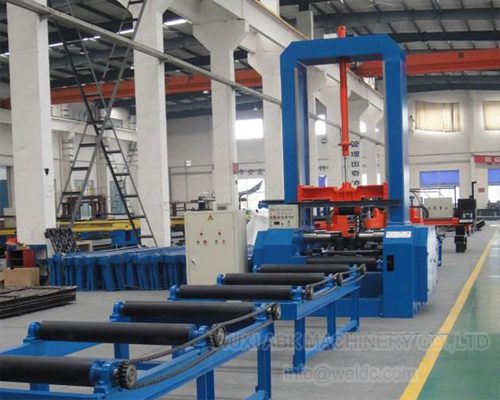
Clamping and fixturing words complete the set. A chuck is a mandril in much of Latin America and a plato de garras in Spain, with a three-jaw version described as a plato de tres garras. A ground connection is the pinza de masa or toma de tierra. A welding helmet is a careta in Mexico and a pantalla de soldar in Spain. Fit-up appears as armado, and the machine that assembles a web and two flanges into a beam is a máquina de armado, which is a different purchase from a welding gantry.
Cutting and Edge Preparation Terms in Spanish
Cutting vocabulary sits upstream of the weld but decides whether the joint fits. Oxy-fuel cutting is oxicorte or corte por llama, plasma cutting is corte por plasma, and water jet cutting is corte por chorro de agua. A CNC machine is simply una máquina de corte CNC in most quotations.
Heavy plate work depends on cut edge quality as much as on cut speed. <CNC Flame Cutting: Precision Cutting for Heavy Plate Fabrication> covers precision cutting practice for heavy plate.
Bevel terminology is the most frequent source of edge preparation error. Bisel is standard in Latin America, chaflán is common in Spain, and both words are used for a preparation that may be described by two different angles. A drawing that states 30 grados without saying whether that is the bevel angle or the included angle can produce a preparation that is twice as wide as intended. The safe instruction states the angle type, the root face and the root gap, along with the term used in the drawing.
Where Regional Spanish Changes the Instruction
Regional variation is not an academic curiosity. It changes which operation a sentence describes, and mixed teams amplify the effect because two readers can agree on a word and disagree on the work.
| Concept | Spain | Mexico | Southern Cone |
|---|---|---|---|
| Welding as an operation | soldeo | soldadura | soldadura |
| Welding helmet | pantalla de soldar | careta de soldar | careta |
| Ground connection | toma de tierra, pinza de masa | pinza de masa, grampa de tierra | pinza de masa |
| Filler wire | hilo | alambre | alambre |
| Bevel | chaflán | bisel | bisel |
| Pipe | tubo, tubería | tubería, tubo | caño |
The Spain and Latin America split over soldeo and soldadura is the one that matters most in technical writing. Spanish engineering documents often use soldeo for the operation and soldadura for the joint or the result, while Latin American shops commonly use soldadura for both. A sentence translated without that distinction can read as though the procedure applies to a finished joint rather than to an operation.
This table is a working reference, not a rulebook. Usage shifts by sector, by company and by generation, and a shop that has worked for years on one client’s documents will have absorbed that client’s terms. Confirm the terms with the people who will read them.
Building a Bilingual Glossary Your Fabricators Will Follow
A glossary that lives in an appendix fails. The working version sits in the same field as the term it defines, in both language versions of the same document, so a reader cannot see one without the other.
- Extract the recurring nouns from your own documents first: procedure specifications, drawings, inspection reports and purchase orders. A generic dictionary will not contain the terms your project actually repeats.
- Choose one Spanish term per concept and record it with a diagram or a photograph. An image settles more arguments about a bevel or a defect than a paragraph does.
- Test the draft glossary on the floor. Give a welder and an inspector the same drawing and ask each to describe the required preparation and the acceptance limit in their own words. Disagreement marks the entry that needs work.
- Place the term in the matching field rather than in a separate list. A procedure that names the process formally and the shop name in a note is easier to audit than one that relies on a footnote.
- Control revisions with the document number, the language, the approver and the date, because two current versions in circulation undo every other effort.
| Field to fix in the glossary | What to request from the other side | What it prevents |
|---|---|---|
| Process name | Formal Spanish name plus the shop name used on site | A procedure applied to a different process |
| Position and direction | Code, Spanish name, and ascendente or descendente | Qualification gaps hidden by one word |
| Defect terms | The term used in the inspection report, matched to the acceptance criterion | Repair instructions written against a different word |
| Joint and edge detail | Bevel angle or included angle, root face, root gap | Edge preparation to the wrong geometry |
| Equipment function | Rotate, tilt or lift, with load and diameter range | A quotation for the wrong machine category |
| Revision control | Document number, language, approver, date | Two current versions in use |
One boundary belongs here. Terminology control does not replace welder qualification, procedure qualification or code compliance, and a perfectly consistent glossary will not rescue an unqualified welder. What it does is remove a failure mode that no qualification scheme covers, which is two competent people reading the same requirement differently.
Send Your Weld Details and We Will Match the Equipment
If you are preparing a bilingual package and the equipment scope is still open, send the process list with the formal Spanish names you use, the position codes and direction, the workpiece diameter and weight range, and whether the workpiece must rotate, tilt or rise. We will reply with the equipment configuration that fits those conditions and the terms we would use on the datasheet, so the Spanish and English versions describe one machine.
WUXI ABK MACHINERY CO., LTD builds welding positioners, rotators and cutting equipment for fabrication shops. We do not qualify welders, certify procedures or act as your translation authority; those stay with your welding engineer and your inspector. Contact Jan at [email protected] or +86 13616174307.
FAQ
What is welding called in Spanish?
The general word is soldadura, which covers both the operation and the finished joint in most of Latin America. Spanish technical writing often uses soldeo for the welding operation and reserves soldadura for the joint or the result. The verb is soldar, and a welder is a soldador.
Is TIG welding called something different in Spanish?
The formal name is soldadura por arco con electrodo de tungsteno y gas protector. On site it is almost always soldadura TIG, and in much of Latin America you will also hear soldadura de argón. That last term is convenient but incomplete, because it does not state whether the shielding gas is pure argon or a mixture, so documents should use the formal name or add the gas.
Which Spanish terms cause the most confusion in fabrication?
Four pairs account for most of it. Soldeo and soldadura separate in Spain but not in Latin America. Bisel and chaflán both mean bevel but sit in different regions. Socavación and mordedura describe the same undercut. Careta and pantalla both mean welding helmet. None of these is a translation error, which is why a spell check will never catch them.
Do Spanish-speaking welders use the same position codes?
Yes. The 1G to 6G codes and the F equivalents are international and appear on drawings and qualification records regardless of language. What changes is the descriptive name beside the code, such as posición plana or posición sobre cabeza, and the progression direction, ascendente or descendente, which should always be stated.
How should Spanish terminology be handled in a WPS or drawing package?
Keep one term per concept and place it in the same field on both language versions, not in an appendix. Give the formal Spanish name for the process, then the shop name in a note, and state position direction, bevel angle type, root face and root gap explicitly. Have a welder and an inspector read the same drawing independently, and treat any disagreement as the entry that needs rewriting before issue.
If you’re interested, check out these related articles:
Boiler Production Lines: Tube to Panel Manufacturing Explained
CNC Flame Cutting: Precision Cutting for Heavy Plate Fabrication
Achieve Production Success With One-Stop Welding Automation
Wind Tower Welding Lines: Designing for Peak Production
Adjustable Welding Rotator for Different Diameter Vessel Welding