Industrial Welding Rotator Types & Structural Designs
Table of Contents
- How Welding Rotators Actually Work
- Conventional Welding Rotators Handle Uniform Diameters
- Adjustable Welding Rotators Accommodate Diameter Variation
- Self-Aligning Welding Rotators Adjust Automatically
- Matching the Rotator Type to the Application
- Frequently Asked Questions About Welding Rotators
- What separates conventional and self-aligning rotators in terms of load capacity and workpiece range?
- How does an adjustable rotator reduce setup time compared to a fixed-center design?
- Which rotator type works best for automated pipeline welding?
- Can rotators be customized for unusual workpiece geometries or load requirements?
- What maintenance keeps a welding rotator running reliably?
Welding cylindrical or irregular workpieces consistently demands equipment that does more than just hold the part in place. Welding rotators deliver controlled rotation so the torch angle and travel speed stay where they need to be throughout the pass. The result is cleaner welds, fewer defects, and less manual handling of components that can weigh several tons. Different rotator configurations suit different fabrication scenarios, and understanding those differences determines whether a shop gains efficiency or creates bottlenecks.
How Welding Rotators Actually Work
A welding rotator positions a cylindrical workpiece and turns it at a speed the operator selects. The weld joint stays in the flat or horizontal position, which is where most welding processes produce their best penetration and bead profile. Adjusting rotation speed to match wire feed, amperage, and material thickness keeps the arc stable and the heat input consistent.
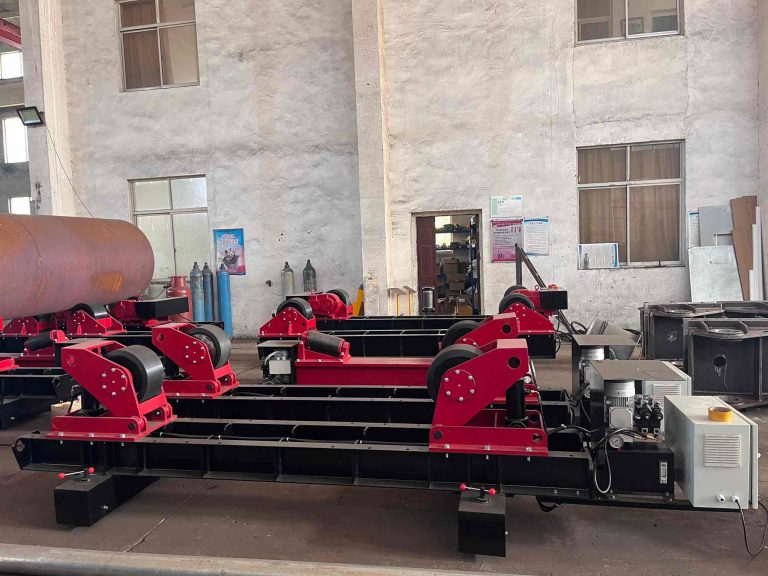
The mechanical arrangement is straightforward: a drive unit with powered rollers and an idler unit with free-spinning rollers. The drive unit controls rotation while the idler carries part of the load and keeps the workpiece tracking straight. Roller surfaces are typically steel for heavy loads or polyurethane when surface marking is a concern.
This setup removes the need for an operator to reposition a hot, heavy shell by hand. On a 10-ton pressure vessel, that repositioning might otherwise happen dozens of times per shift. Eliminating it cuts cycle time and reduces the injury exposure that comes with moving mass that does not want to stop once it starts rolling.
Conventional Welding Rotators Handle Uniform Diameters
Conventional welding rotators use fixed-center rollers. The spacing between rollers is set during installation or adjusted infrequently with mechanical stops. This configuration works well when the shop runs the same diameter repeatedly, which is common in tank fabrication, large-diameter pipe production, and pressure vessel work.
The design prioritizes load capacity and durability over quick changeover. A conventional rotator rated for 100 tons can run continuously through a multi-pass weld on a thick-wall vessel without thermal or mechanical fatigue becoming a factor. The rollers are wide enough to distribute contact pressure and prevent localized deformation on the shell.
| Specification | Typical Range |
|---|---|
| Load Capacity | Up to 100 tons |
| Workpiece Diameter | 500 mm to 5000 mm |
| Roller Type | Fixed center, steel or polyurethane |
| Speed Control | Variable frequency drive |
Shops that weld storage tanks or process vessels often standardize on conventional rotators because the workpiece dimensions fall within a narrow band. The equipment pays for itself through reliability rather than flexibility.
Adjustable Welding Rotators Accommodate Diameter Variation
When workpiece diameters change frequently, an adjustable welding rotator reduces the time spent reconfiguring equipment. The roller spacing moves manually, usually with a screw mechanism or hydraulic cylinder, so the same rotator can handle a 600 mm pipe in the morning and a 1500 mm shell in the afternoon.
This flexibility matters in job shops and contract fabrication where the production schedule includes multiple part numbers per week. Setup time that drops from 45 minutes to 10 minutes compounds across dozens of changeovers per month.
Adjustable rotators also integrate well with positioning fixtures when the workpiece is not a simple cylinder. A conical section or a shell with nozzle cutouts can still rotate smoothly if the roller spacing matches the effective diameter at the contact points.
The trade-off is that manual adjustment introduces a step where an error can occur. If the rollers are set too narrow, the workpiece rides high and can slip. Too wide, and the contact angle becomes shallow enough that the drive loses traction. Operators need to verify the setup before starting rotation, especially on heavy parts where a slip creates a safety incident.
Self-Aligning Welding Rotators Adjust Automatically
Self-aligning welding rotators sense the workpiece diameter and move the rollers to match without operator intervention. The adjustment happens continuously, so a workpiece with a taper or a diameter step transitions smoothly as it rotates.
This automatic response is what makes self-aligning rotators the standard choice for automated welding cells. A robotic welding system cannot pause to wait for an operator to reset roller spacing. The rotator must track the workpiece geometry in real time and maintain consistent support throughout the weld.
| Feature | Function |
|---|---|
| Auto-adjustment | Rollers follow workpiece diameter changes during rotation |
| Control System | PLC integration for speed, direction, and position feedback |
| Application | Pipeline, wind tower, and pressure vessel automation |
| Precision | Maintains fit-up accuracy for orbital and longitudinal welds |
Pipeline fabrication is a common application. A pipe string may include sections with slightly different outside diameters due to wall thickness variation or manufacturing tolerances. A self-aligning rotator keeps all sections centered and rotating at the same surface speed, which is critical for consistent weld quality when the torch is locked in position.
Wind tower manufacturing presents a similar challenge. The tower sections are large-diameter cones, and the diameter changes continuously along the length. A self-aligning rotator tracks that change and keeps the weld seam in position for the welding head.
If your automated welding line requires consistent fit-up across varying workpiece geometries, discussing the control interface and feedback resolution with the rotator supplier before finalizing the cell layout prevents integration problems later.
Matching the Rotator Type to the Application
The decision between conventional, adjustable, and self-aligning rotators depends on three factors: workpiece geometry, production volume, and automation level.
A shop running the same 2-meter-diameter tank shell in batches of 50 units does not need automatic adjustment. A conventional rotator with the rollers set once handles the entire run. The capital cost is lower, and there are fewer components that can fail.
A fabricator building custom pressure vessels with diameters ranging from 800 mm to 3000 mm benefits from adjustable rotators. The flexibility justifies the additional setup discipline required.
An automated cell welding pipeline spools or wind tower sections needs self-aligning rotators. The cost premium is offset by the elimination of manual intervention and the consistency that automation demands.
Load capacity is a parallel consideration. A rotator rated for 20 tons cannot safely handle a 25-ton workpiece regardless of how well the diameter matches. Overloading stresses the bearings, risks roller slip, and can damage the workpiece surface.
Workpiece length also matters. A long shell needs adequate support spacing to prevent deflection. Some applications require multiple rotator sets in tandem, with synchronized drive control to prevent torsional stress on the workpiece.
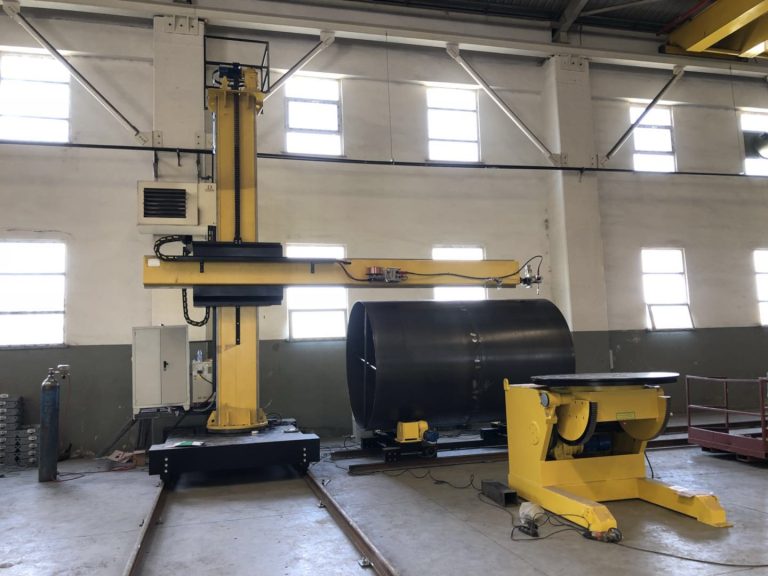
Integration with welding manipulators and column-and-boom systems is another factor. The rotator speed must coordinate with the manipulator travel speed to maintain the correct weld bead overlap. Control systems that communicate between the rotator and the manipulator simplify this coordination.
Maintenance requirements differ by type. Conventional rotators have fewer moving parts and longer service intervals. Self-aligning rotators have hydraulic or electromechanical adjustment systems that require periodic inspection and calibration.
Frequently Asked Questions About Welding Rotators
What separates conventional and self-aligning rotators in terms of load capacity and workpiece range?
Conventional rotators often reach higher load capacities because the fixed roller arrangement allows for heavier structural components. A 100-ton conventional rotator is common in heavy vessel fabrication. Self-aligning rotators typically max out at lower capacities, though units rated for 60 tons or more exist for wind tower and offshore applications. The practical difference is that conventional rotators handle a narrow diameter range efficiently, while self-aligning rotators handle a wide diameter range automatically. A shop welding uniform cylinders in the 1000 mm to 1500 mm range gains nothing from self-aligning capability. A shop welding tapered sections or mixed-diameter assemblies cannot function without it.
How does an adjustable rotator reduce setup time compared to a fixed-center design?
An adjustable rotator lets the operator change roller spacing in minutes rather than repositioning the entire unit or swapping roller assemblies. On a fixed-center rotator, accommodating a different diameter may require moving the idler unit, shimming the rollers, or using a different rotator altogether. The adjustable design consolidates those steps into a single mechanical adjustment. In a job shop environment where the production schedule includes five or six different diameters per week, the cumulative time savings can exceed several hours of productive welding time.
Which rotator type works best for automated pipeline welding?
Self-aligning rotators are the standard for automated pipeline work. The pipe sections rotate through the welding station without manual intervention, and the rotator tracks any diameter variation automatically. This is essential for orbital welding heads that maintain a fixed position relative to the pipe centerline. A conventional or adjustable rotator would require an operator to verify and correct the setup between sections, which defeats the purpose of automation. The control system integration also matters: the rotator PLC needs to communicate with the welding controller to synchronize rotation speed with weld parameters.
Can rotators be customized for unusual workpiece geometries or load requirements?
Custom configurations are common in heavy fabrication. A workpiece with an eccentric center of gravity, non-circular cross-section, or unusual length may require modified roller profiles, extended bases, or tandem rotator arrangements. The engineering involves calculating the contact geometry, load distribution, and drive torque for the specific application. Lead times for custom units are longer than for standard catalog models, so planning the equipment procurement early in the project schedule avoids delays. To discuss specific requirements, contact [email protected] or call +86 13616174307.
What maintenance keeps a welding rotator running reliably?
Routine maintenance includes inspecting the rollers for wear and surface damage, checking gearbox oil levels and condition, verifying electrical connections and drive calibration, and confirming that safety interlocks function correctly. Polyurethane rollers wear faster than steel rollers and need replacement when the surface becomes glazed or cracked. Self-aligning rotators require additional attention to the adjustment mechanism, whether hydraulic cylinders, lead screws, or linear actuators. Following the manufacturer’s maintenance schedule and documenting service history helps identify wear patterns before they cause unplanned downtime.
If you’re interested, you may want to read the following articles:
Welding Rotator vs Manual Pipe Welding: Productivity & Cost Efficiency