Oil & Gas Storage Tank Welding: API-Certified Welding Equipment Selection
Table of Contents
- Why Welding Equipment Affects Storage Tank Code Compliance
- Key API Codes Every Tank Welding Engineer Must Know
- Core Welding Equipment for API-Compliant Tank Construction
- Automating Welding to Achieve Consistent Code Adherence
- Evaluating Welding Equipment Suppliers for Code Readiness
- Overcoming Common Code-Related Welding Challenges in Tank Construction
- Questions Tank Builders Ask About Welding Equipment and Codes
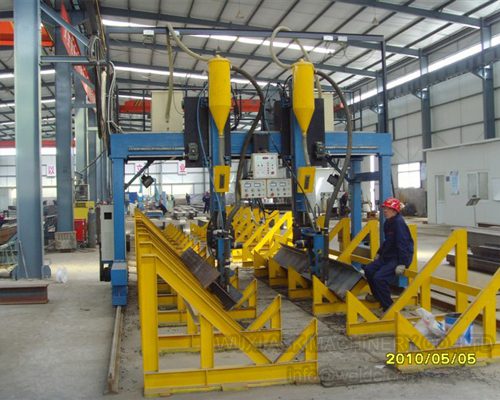
For many fabricators, achieving code compliance on an oil and gas storage tank feels like mastering the welding procedure alone. But after more than twelve years integrating automated welding systems for global tank projects, I’ve seen that the equipment you choose often determines whether you meet API requirements from the very first seam. API 650 and API 620 are not just weld quality standards—they specify fabrication tolerances, mechanical properties, and inspection criteria that demand specific machine capabilities. This article maps those requirements directly to the welding equipment that delivers consistent compliance, drawing on my experience designing and commissioning tank welding production lines for Wuxi ABOKE Machinery.
Why Welding Equipment Affects Storage Tank Code Compliance
API 650 and similar codes are built on a simple premise: the tank must retain its contents under design pressure, temperature, and seismic loads. Welding defects—undercut, lack of fusion, excessive distortion—are the fastest path to a failed hydrotest or a premature repair. The welding machine’s arc characteristics, travel speed control, and positioning accuracy shape the weld profile and heat input directly. If the equipment cannot hold a steady arc length across a long girth seam or maintain consistent travel speed on a variable plate thickness, the resulting weld may pass visual inspection but fail radiography. In projects I’ve supported, the difference between a code-compliant tank and a costly rework was often traced back to whether the welding rotator and manipulator maintained alignment within a 2 mm tolerance over a 20-meter circumference. That mechanical precision is as important as the welding parameter settings.
Key API Codes Every Tank Welding Engineer Must Know
Storage tank fabrication in the oil and gas sector falls under several American Petroleum Institute standards, each with its own welding requirements. The most relevant are:
- API 650: Welded Tanks for Oil Storage. This governs the majority of aboveground storage tanks up to 260°F. It specifies joint design, welder qualification, and NDE methods based on shell thickness and material group. Welding equipment must accommodate full-penetration butt welds, fillet welds, and often automated submerged arc welding (SAW) for maximum deposition with minimal defects.
- API 620: Design and Construction of Large, Welded, Low-Pressure Storage Tanks. When the tank operates above 2.5 psig or below atmospheric temperature, this code applies. Welding procedures must meet ASME Section IX in addition to API 620 rules. Equipment selection for these tanks often involves more stringent heat input control and multi-pass welding, as distortion from welding can compromise the required roundness and nozzle alignment.
- API 653: Tank Inspection, Repair, Alteration, and Reconstruction. While not a construction code, it drives the demand for field welding equipment that can match new-construction quality during repairs and alterations. Portable welding manipulators, fit-up rotators, and vertical electrogas welding (EGW) systems are commonly needed for on-site compliance work.
Each code references additional standards for welding consumables (AWS A5.1, A5.17), NDE (ASME Section V), and structural integrity, so your equipment documentation must support the full chain of compliance.
Core Welding Equipment for API-Compliant Tank Construction
Meeting API 650 or 620 requires a core set of machines that work together to maintain plate alignment, joint fit-up, and weld quality. Based on hundreds of tank projects I’ve consulted on, here is the essential line-up and what each unit must deliver.
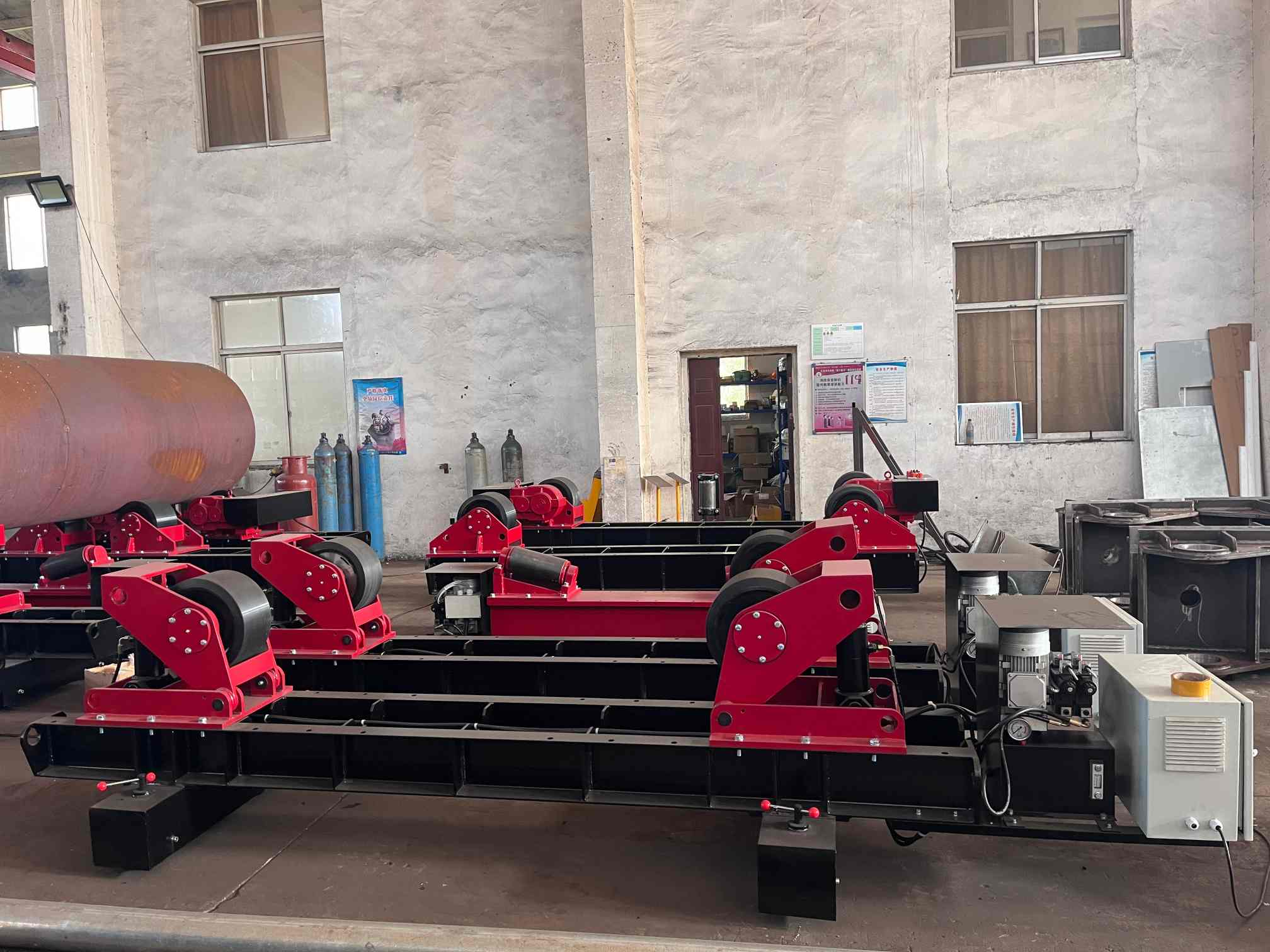
- Welding rotators and fit-up rotators: For cylindrical tank shells, the vessel is turned by rotators while a welding head runs the seam. API 650 calls for shell plate overlays and butt welds with misalignment limits often under 1.6 mm. Self-aligning rotators maintain that alignment automatically. Load capacity is critical—a 100-ton rotator set for a 40-meter-diameter tank must run smoothly at low RPM without jerking, which would cause arc wander. For circumferential seams, fit-up rotators with hydraulic clamping align adjacent shell courses before tack welding. I always recommend rotators with variable speed control and anti-creep features, because any drift changes the travel speed and invalidates the qualified WPS parameters.
- Welding manipulators (column and boom): These position the welding head over the seam. For large tanks, a 4×4 meter or larger manipulator is typical. Code compliance demands absolute positioning repeatability, because the qualified welding procedure requires a specific electrode extension and travel speed. A manipulator with CNC control and linear guides maintains the pre-set distance from the workpiece across long travel strokes, eliminating the human variability that causes local underfill or overlap. We configure our manipulators with SAW or MIG/MAG heads and oscillation capabilities for wide weld caps, a feature that saves pass counts and reduces distortion on thick plates.
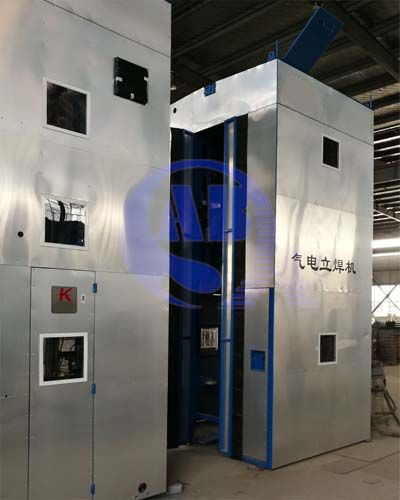
Vertical electrogas welding (EGW) machines: For large storage tanks with shell heights over 30 meters, vertical seams are often welded using the electrogas process. This single-pass vertical welding method relies on a water-cooled copper shoe that holds the molten pool. EGW equipment must maintain a constant gap bridge between the shoe and the plate, or the weld will have lack of fusion or slag entrapment. Our EGW machines include automatic gap sensing and shoe pressure control, which proved decisive in a recent 80,000 cubic meter crude oil tank where 20-meter vertical seams had zero radiograph-related cutouts.
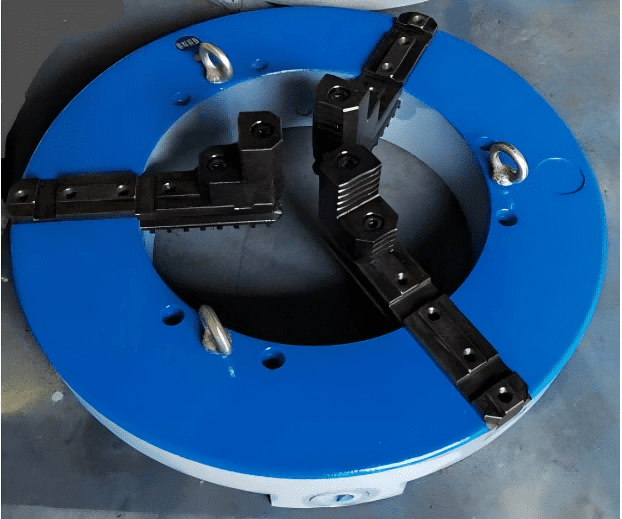
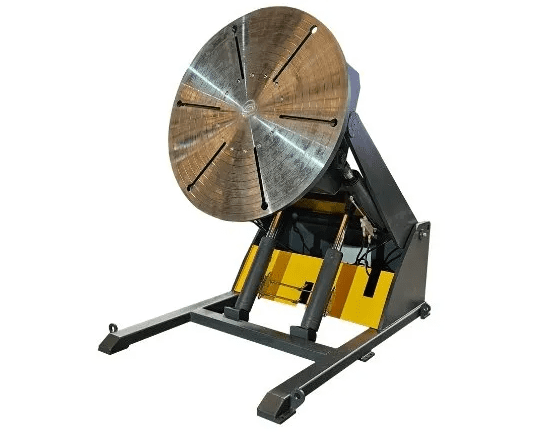
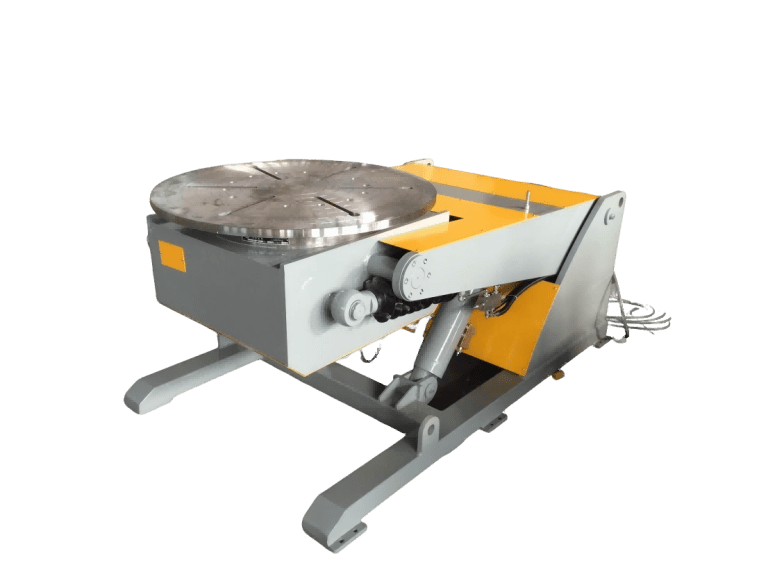
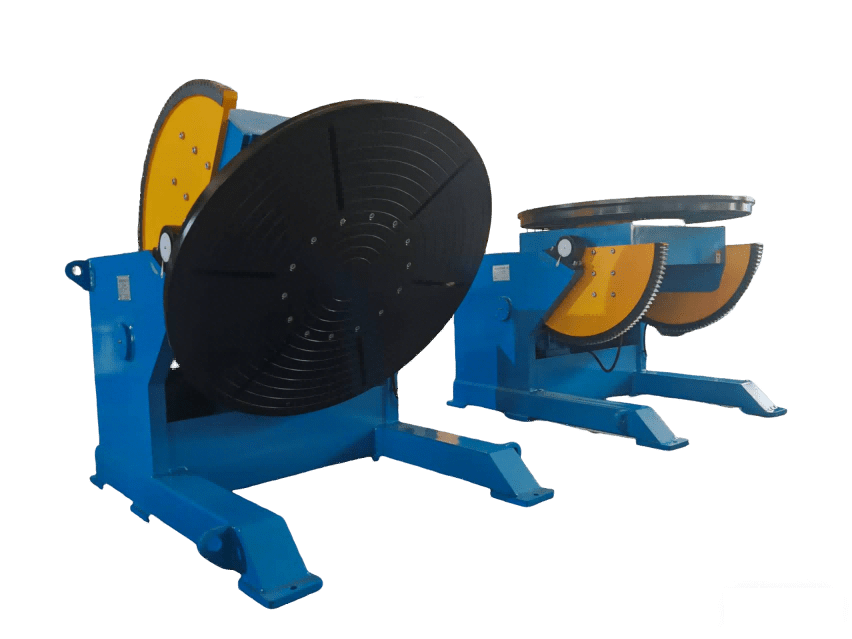
Welding positioners: For attachments like nozzles, flanges, and manways, a head-and-tail positioner or a 3-axis hydraulic positioner lets you rotate the subassembly to the flat position for welding. This is often overlooked but directly affects the quality of these critical Category D joints under API 650. Positioners with rotation accuracy of ±0.1 mm ensure root gap consistency and reduce the need for back gouging.
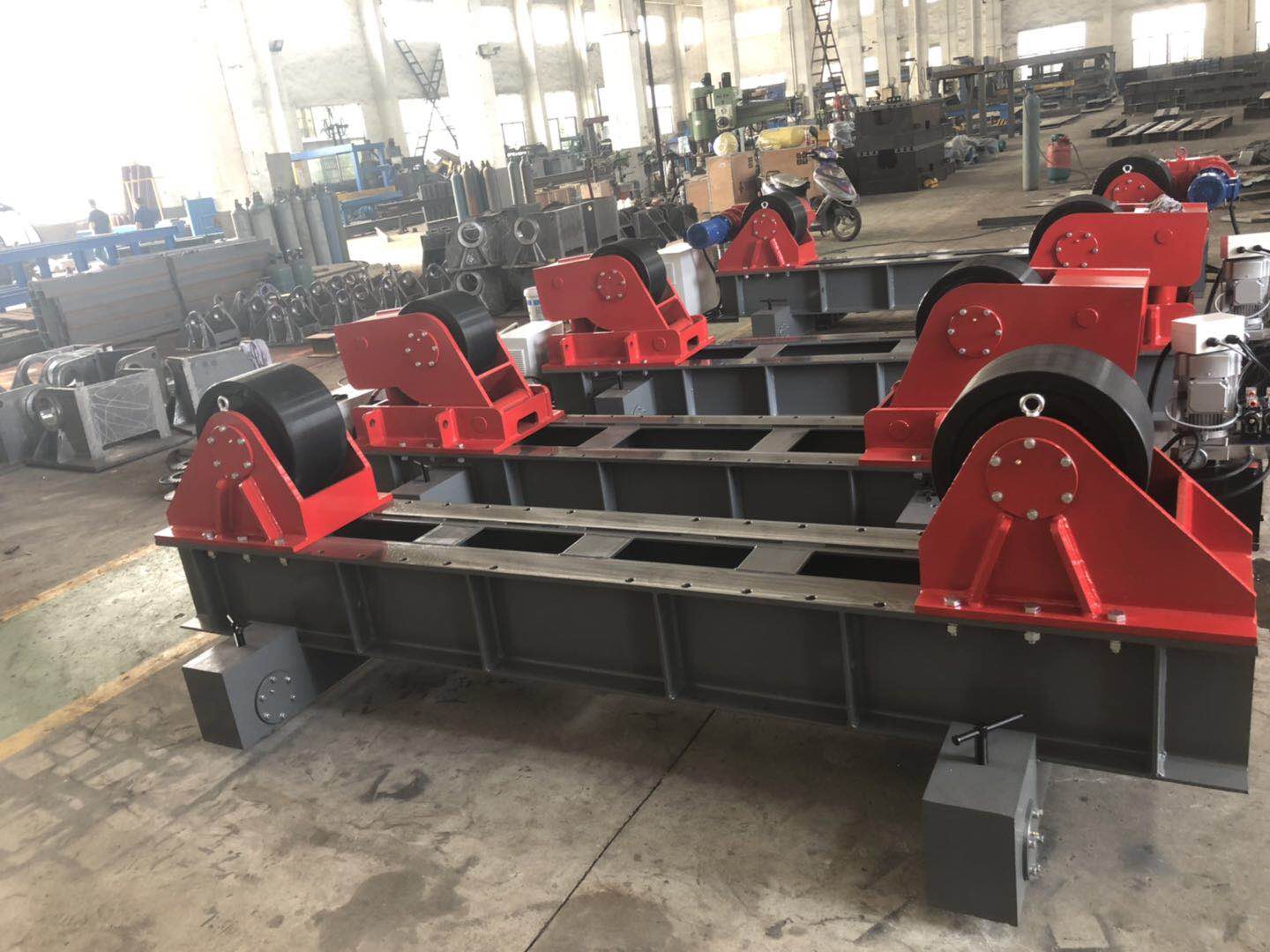
Below, a comparison of the primary equipment types and their code-related roles:
| Equipment | Primary Code Function | Critical Specification |
|---|---|---|
| Welding rotator (conventional) | Rotates shell courses for girth welding | Load capacity, alignment accuracy |
| Self-aligning rotator | Automated alignment for API 650 joint tolerance | Anti-drift control |
| Column & boom manipulator | Positions SAW/MIG head for longitudinal and girth seams | Travel repeatability ±0.5 mm |
| EGW machine | Vertical seam single-pass welding for large tanks | Gap sensing and copper shoe pressure |
| L-type / hydraulic positioner | Positions nozzles, flanges, manways for flat welding | Rotation accuracy, load rating |
Automating Welding to Achieve Consistent Code Adherence
Manual welding always introduces variability—the welder’s travel speed, arc length, and electrode angle shift throughout a shift. API codes allow manual welding but demand uniform quality, which means relying on operator skill to replicate the qualified WPS on every joint. Automation removes most of those variables. A CNC welding manipulator paired with a rotator delivers exactly the same heat input, travel speed, and bead placement on the 100th shell course as on the first. This is especially critical when welding materials like A516 Grade 70 or stainless steel overlays, where heat input must stay within a narrow window to avoid loss of toughness or corrosion resistance.
In our experience, moving from manual SAW to automated column-and-boom welding reduced repair rates on girth seams from about 5% to under 1% in a series of 50,000 cubic meter tanks built to API 650. The automation also allowed real-time data logging of welding parameters for third-party inspector review, strengthening the certification package. If your program involves both API 650 and ASME Section VIII pressure vessel work, it is worth confirming that your welding automation can store and recall multiple PQR-approved procedures. Reach out to us at [email protected] if you need to evaluate how your current equipment handles procedure switching.
Evaluating Welding Equipment Suppliers for Code Readiness
Not every supplier understands the intersection of machine design and welding code requirements. I’ve walked through factories with beautiful machinery that would fail a code audit because their documentation didn’t support qualified welding procedures. When evaluating a supplier, look beyond the catalog sheets. Request evidence that their equipment has been used in verified code-compliant projects. Check whether the rotator manufacturer can provide material certifications for the rollers and base castings. Ask whether their manipulator controls allow parameter reset to a qualified WPS after a power interruption—a detail often missed but important for traceability.
At Wuxi ABOKE, we build our welding equipment around the need to pass third-party inspections. Every rotator set we ship includes calibration certificates for the motor-drive synchronization and alignment tolerance. For storage tank projects, we pre-configure the SAW head with oscillation parameters matched to the client’s WPS and provide a weld map template for the inspector. This kind of detail is what separates a general machine shop from a partner who can share the compliance burden.
Overcoming Common Code-Related Welding Challenges in Tank Construction
Even with the right equipment, tank welding throws challenges that can trip up code compliance. Below are the three issues I see most often and how to overcome them with proper machine selection and setup.
Distortion control on thin-to-medium shell plates
API 650 tanks often use shell plates from 6 mm to 40 mm. On the thinner range, excessive heat input causes shell peaking and banding that exceed the code’s out-of-roundness tolerances. The solution is not just reducing current but using a welding manipulator with oscillation and pulse capability to deposit the required weld metal with minimal heat. The combination of low heat input and consistent travel speed keeps shell deformation within the 1% diameter limit.
Tack weld inspections and failures
Many code auditors look critically at tack welds because they often hide lack-of-fusion defects under the final pass. I always advise using fit-up rotators with precise root gap control and an automatic TIG or MIG tacking system rather than hand tacking. The result is a more uniform root that a SAW process can fuse without leaving embedded defects. This one change eliminated the most frequent source of radiograph cutouts in a recent 30-meter tank project I consulted on.
Weldability of high-strength steels for low-temperature service
API 620 tanks for refrigerated storage often use A537 Class 1 or Class 2 steel, which is sensitive to heat input and requires strict preheat and interpass control. Automated SAW systems with integrated temperature monitoring and automatic preheat stations maintain the required 150°C interpass temperature across the entire circumference. Without this automation, the temperature drop on the far side of a large tank circumference causes hardness peaks in the heat-affected zone, risking code rejection by hardness testing.
Questions Tank Builders Ask About Welding Equipment and Codes
How do I know my welding rotator meets API 650 alignment requirements?
The key is load-deflection data. Request the manufacturer’s alignment tolerance under your maximum load, not unloaded. A rotator that holds 1.5 mm over its full capacity is usually acceptable. In our testing, we measure actual roller runout under load and provide the certificate with the machine. Pair the rotator with a self-aligning feature if your shell sequences vary in diameter.
Can standard welding manipulators handle the high deposition rates API 650 demands?
Yes, but only if the manipulator’s travel carriage and mast are designed for continuous high-speed travel under heavy wire feed. A manipulator with lightweight square-tube construction may vibrate at higher speeds, causing arc instability. Look for cast or welded box construction and linear guideways. We rate our manipulator carriages for 0–1200 mm/min travel speed with minimal deflection, which supports deposition rates up to 15 kg/hour with twin-wire SAW.
What documentation should I receive with the welding machine to satisfy an API inspector?
At minimum, the supplier should provide material certificates for structural components, calibration certificates for the travel drives and speed indicators, and a type test report showing the machine’s performance under a simulated WPS. We also supply a pre-validation weld map showing how the machine’s parameters align with the client’s PQR. This pre-validation saves days of inspector questioning on site.
Is vertical electrogas welding accepted under API 650?
Yes, EGW is an approved process. API 650 Section 5.7 allows qualified EGW procedures for vertical shell seams. The critical requirement is that the consumables and procedure are qualified per Section 9, and that the machine can deliver consistent gap bridging without discontinuities. For large-diameter tanks, EGW reduces vertical seam welding time by 60–70% compared to manual SMAW, while improving radiography pass rates. If your project is new to EGW, share your shell plate specifications and we’ll confirm which EGW configuration matches your code requirements.
For tank fabricators and project engineers, navigating the gap between code requirements and equipment capabilities is where projects lose time and money. Whether you are expanding a tank farm or building new storage capacity, matching your welding equipment to API 650, 620, or dual-code requirements is not a catalog exercise—it depends on load capacity, positioning precision, and automation capability. I encourage you to share your specific tank dimensions, material grade, and target code with us. Send your requirements to [email protected] or call +86 13616174307. Our team can confirm which equipment configuration will deliver compliance from the first weld.
If you’re interested, check out these related articles:
CNC Water Jet Cutting: Precision, No Heat, Any Material
Welding Manipulators for Storage Tanks: Girth and Seam Automation
Adjustable Welding Rotator for Different Diameter Vessel Welding
Precision Positioning for Pipe and Shaft Welding Workpieces
Fit-Up Rotator for Accurate Vessel Alignment & Stable Welding