Welding Column and Boom: How It Works and Selection Guide
Table of Contents
- The Core Components of a Welding Column and Boom
- How Column and Boom Travel Affects Weld Quality
- Matching the Manipulator to Your Workpiece and Power Source
- Control Modes and Operator Safety Requirements
- Column and Boom Selection for Heavy Fabrication
- Common Questions About Welding Column and Boom Equipment
- What is the difference between a fixed base and a traveling column and boom?
- How much boom extension do I actually need for vessel work?
- Can a welding column and boom run different processes, or only submerged arc welding?
- What information should I send before requesting a quotation?
A welding column and boom positions a submerged arc welding head, flux system, and wire feeder over long workpieces such as storage tanks, pressure vessels, wind tower shells, and H beams. The column carries vertical travel while the boom extends horizontally so operators can weld long seams and circumferential joints without repositioning the part. I have worked with these stations in vessel shops where boom travel speed drift shifted arc voltage and produced uneven penetration. The machine is straightforward in concept, but specification errors in boom rigidity, drive control, and rotator pairing are common. The sections below explain how the equipment works and how to specify a station that will produce repeatable welds from the first pass.
The Core Components of a Welding Column and Boom
Most buyers first see a column and boom as a tall vertical post with a horizontal arm, but the working assembly includes several components that determine how the station runs. A welding manipulator in this configuration starts with a fabricated base, a vertical column, a motorized carriage, and a horizontal boom that carries the welding head, wire reel, flux hopper, and control cables. The carriage moves up and down on the column; the boom travel moves the torch along the horizontal axis. On larger stations, an operator chair travels with the boom so the welder can watch the arc and adjust travel speed. Flux recovery and wire feed systems are mounted on the boom platform to keep the working arc area clear. The base may be fixed to the shop floor or mounted on a rail system for traveling along the workpiece.
How Column and Boom Travel Affects Weld Quality
Travel speed is not just a productivity setting. In submerged arc welding, travel speed, voltage, wire feed speed, and flux depth work together to control deposition rate and bead shape. If the boom carriage accelerates unevenly or the rail alignment is off, the arc sees a rapid change in travel speed and the bead width changes. I have seen a 4 mm shift in torch position from a heavily loaded boom alter the weld toe line on a vessel longitudinal seam. Stiff column sections, hardened and ground guide rails, and a variable frequency drive with stable low speed control matter more than the nominal speed range. For long seams, even a few millimeters of boom deflection under load will move the contact tip, change stickout, and affect penetration.
Matching the Manipulator to Your Workpiece and Power Source
Column and boom machines are often specified by boom reach and column height, but the more important match is between travel speed range, rotator speed, and the power source output. A 1,000 A submerged arc power source running a 4 mm wire needs a travel speed range that can hold deposition rate within the arc parameters. If the boom travel cannot run slow enough for a heavy circumferential pass, the operator compensates by changing voltage or wire feed, which changes penetration and flux consumption. The table below lists the information I ask for when reviewing a station design.
| Selection Factor | What to Specify | Why It Affects Weld Quality |
|---|---|---|
| Workpiece diameter | Tank or vessel outer diameter and length | Determines rotator speed and required boom travel range |
| Seam orientation | Longitudinal, circumferential, or both | Sets whether the boom travels horizontally or the rotator rotates the part |
| Power source | DC or AC SAW output and wire diameter | Travel speed must match deposition parameters for the current and wire feed |
| Rotator capacity | Load weight, diameter range, and speed control | Rotator and boom travel must synchronize for consistent circumferential travel speed |
| Boom extension | Maximum horizontal reach under full load | Longer reach increases deflection and demands a stiffer boom structure |
| Control requirement | Manual pendant, semi automatic, or programmed | Determines whether speed settings are adjusted by the operator or stored in the control system |
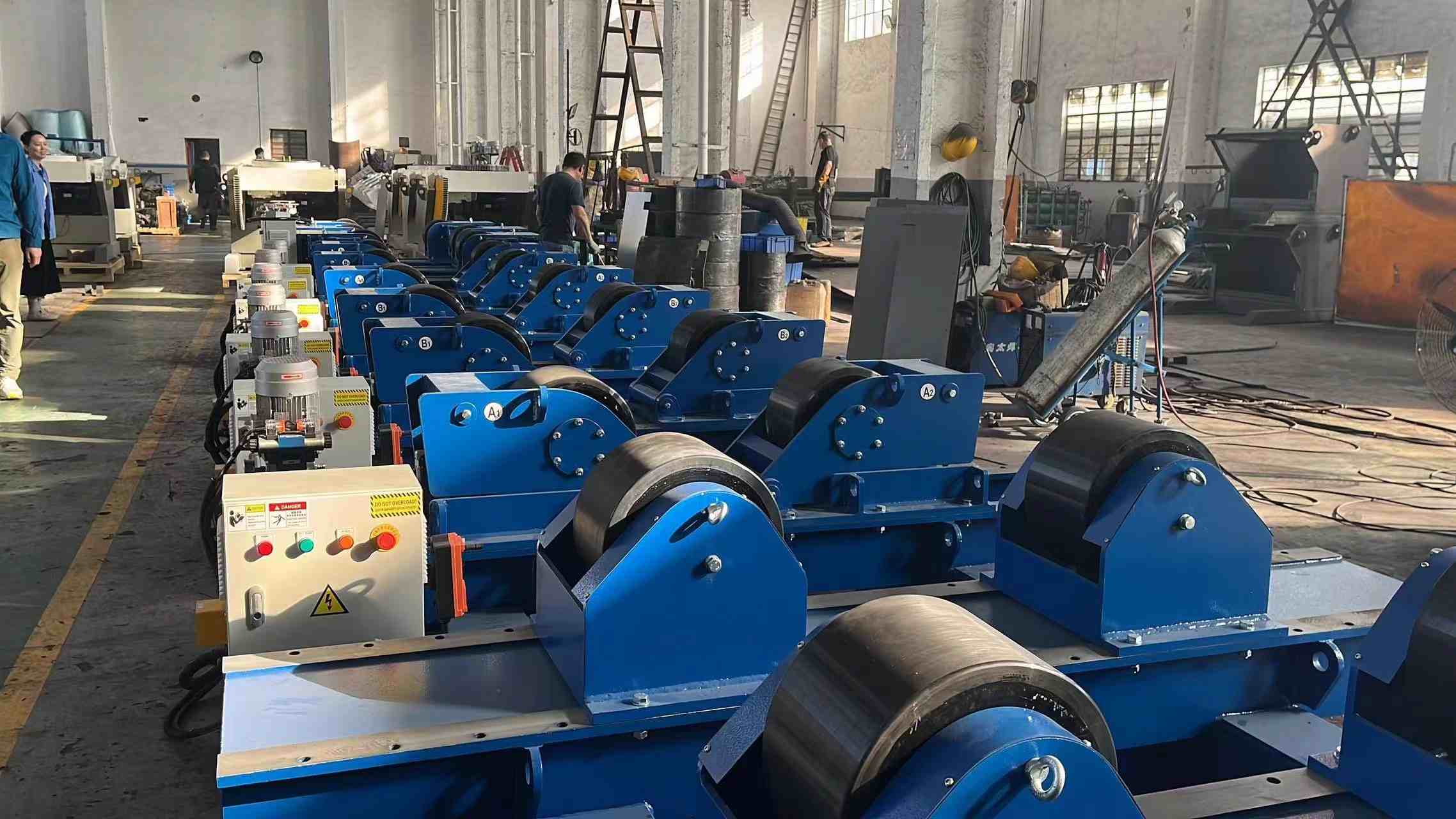
If your program involves circumferential seams on vessels above 3 m diameter or longitudinal seams longer than 6 m, it is worth confirming travel speed modulation and rotator synchronization before finalizing your BOM. Send your part dimensions and power source model to [email protected].
Control Modes and Operator Safety Requirements
A column and boom station can run in manual, semi automatic, or programmed control modes depending on the application. Manual pendant mode gives the operator direct control of vertical and horizontal travel. Semi automatic mode holds travel speed and arc voltage while the operator monitors the weld pool. Programmed mode stores parameters for repeated long seams and can work with a welding rotator to coordinate circumferential travel. Safety requirements are not optional add ons. The boom must have travel limits, anti fall protection, emergency stop controls at the pendant and operator chair, and cable management that prevents the wire feeder from dragging against the boom frame. On any site installation, I require a level foundation and rail alignment check before commissioning because a binding rail can overload the drive and create an arc stability problem.
Column and Boom Selection for Heavy Fabrication
Heavy fabrication shops use column and boom stations for storage tanks, wind tower sections, pressure vessels, and H beam sub assembly because the equipment reduces operator fatigue and improves repeatability on long welds. A fixed base station works when the workpiece can be positioned in front of the column. A traveling base station works when the workpiece is too long to reposition or when multiple workstations share one boom. At Wuxi ABOKE Machinery, we configure these stations with adjustable welding rotator and fit up rotator equipment for vessel and tank production. The selection process starts with the workpiece envelope and the seam sequence, not with the machine catalog number.
Long seam quality problems usually trace back to three things: boom rigidity, travel speed consistency, and whether the manipulator was paired with the right rotator and power source at the specification stage. If you are preparing a welding station for tanks, vessels, or wind tower shells, send your workpiece dimensions, seam lengths, and power source model to [email protected] or call +86 13616174307. We will review the configuration and confirm the correct column height, boom extension, and travel control before you finalize the purchase.
Common Questions About Welding Column and Boom Equipment
What is the difference between a fixed base and a traveling column and boom?
The fixed base stays in one position; the traveling base adds a floor mounted rail so the entire machine can move along the workpiece. A fixed base is easier to level and costs less, but the workpiece must be moved or rotated into position before each long seam. A traveling base makes sense when the part cannot be repositioned easily or when one boom must serve several workstations. The tradeoff is rail alignment and foundation work, which require careful installation to avoid travel speed variation.
How much boom extension do I actually need for vessel work?
A common mistake is to assume the boom must reach the entire vessel length. The boom and the rotator work together, so the horizontal travel only has to cover the longitudinal seam path that the rotator cannot handle. For circumferential seams, the rotator rotates the vessel under a fixed boom position. Measure from the column center to the farthest longitudinal weld line plus the torch offset, then add a small margin for setup. Specifying twice the reach you need adds boom deflection and cost without improving weld coverage.
Can a welding column and boom run different processes, or only submerged arc welding?
It depends on the carriage design and the torch mounting. Most column and boom stations are built for submerged arc welding because the wire feed and flux recovery systems are heavy and the process benefits from long continuous seams. The same structure can carry gas metal arc welding or flux cored arc welding heads if the carriage has the correct mounting plate, cable track, and control interface. The process choice is usually settled before placing the order, because the torch assembly and shielding gas routing differ enough to affect the boom load.
What information should I send before requesting a quotation?
In projects I have supported, the fastest quotations come from buyers who send four details: workpiece diameter and length, seam type, power source model, and whether the machine will be fixed or traveling. A drawing of the weldment helps more than a text description because it shows the seam positions that the boom and rotator must cover. If the part has multiple diameters or internal seams, include those conditions as separate line items rather than folding them into one average dimension. Send the four details to [email protected] and we will confirm the matching column height, boom reach, and control configuration for your application.
If you’re interested, check out these related articles:
H-Beam Assembly: Automated Web and Flange Fit-Up Precision
Heavy-Duty Welding Rotators with 200 Ton Load Capacity