Economizer Tube Welding Consistency: A Practical Approach

July 27, 2026
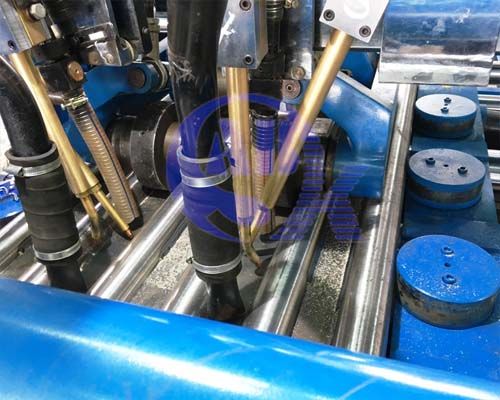
Achieving consistent weld quality in economizer tube production is a persistent challenge for boiler manufacturers. Variations in tube alignment, clamping force, and welding parameters often lead to costly rework and production delays. In my work with automated boiler production lines, I have seen that a systematic approach focusing on precise tube clamping and automated parameter […]
Read More »

Dry Table vs Water Table Plasma Cutting: What Shops Should Know

July 26, 2026

Dry table vs water table plasma cutting is a decision that goes beyond the purchase price. As an industrial welding automation engineer, I have seen shops replace a dry table with a water table and immediately cut grinding time before welding by nearly a third, while others found a water table created more rust headaches […]

Read More »

Control Deformation in Welded Frames: A Practical Approach

July 25, 2026

Welding a fabricated frame often looks straightforward until you release the clamps and watch it spring out of tolerance. In heavy fabrication, cumulative distortion from multiple joints can turn a precision structure into a costly rework job. Controlling deformation in welded frames demands more than remembering a few textbook tips; it requires a systematic approach […]

Read More »

Wind Tower Welding Line Foundation Requirements for Heavy Loads

July 24, 2026

A wind tower welding line handles shell sections weighing 30 to 80 tonnes or more, rotating them on positioners and moving them through multiple stations. Foundation design is not a civil formality. It sets the production ceiling. At ABOKE, I have been called into projects where a workshop floor cracked within six months of commissioning […]

Read More »

Heat Exchanger Shell Welding Automation: A Practical Guide

July 23, 2026

Heat exchanger shell welding automation turns a demanding, variable manual process into a controlled, repeatable manufacturing step. Shells for heat exchangers range from small 300 mm diameters to vessels over 3 meters across, with seam lengths that can stretch beyond 12 meters. Manual welding across these large, heavy workpieces introduces inconsistency in penetration, bead profile, […]

Read More »

H Beam Flux Recovery: Storage, Reuse Practices for Welding

July 22, 2026

Managing submerged arc welding flux in a busy H beam fabrication shop is a direct cost driver many operations overlook. New flux has a purchase price, but the hidden expense is what gets thrown away, contaminated by moisture or mixed with slag, mill scale, and workshop dust. H beam flux recovery and reuse, done correctly, […]

Read More »

Reducing Tank Welding Downtime in Long-Duration Projects

July 21, 2026

Tank construction projects that stretch over weeks or months suffer from more than equipment breakdowns. In my years configuring automated welding lines for large tank fabrication, I’ve seen production slow not because a machine failed, but because one station outran another: a welding rotator waiting on a crane, or a seam welder idling while fit-up […]

Read More »

How to Write a Welding Equipment RFQ for Accurate Quotes

July 20, 2026

An incomplete RFQ for welding equipment almost guarantees a delayed project and inflated prices. When suppliers receive vague inquiries (no workpiece dimensions, no throughput targets, no site conditions), they either waste weeks on clarification rounds or pad their quotes to cover uncertainty. After twelve years in welding automation, I’ve seen the same pattern: buyers who […]

Read More »

Welding Manipulator Control Modes: The 3 Options Compared

July 19, 2026

Welding manipulator control modes directly shape how efficiently a shop can weld large cylindrical sections, pressure vessels, or structural beams. The choice between manual, semi-automatic, and programmed control determines not only the machine’s price but also the skill level required from operators and how consistently production targets are met. Over the past twelve years, I’ve […]

Read More »

Welding Rotator Export Packing: Lifting, Skids, Moisture

July 18, 2026

When a welding rotator arrives at an overseas facility, the difference between immediate installation and a costly refurbishment often traces back to the packing it traveled in. Welding rotator export packing is not about building a heavy crate and stuffing the gaps with polystyrene. It is a planned sequence: designing lifting points that handle the […]

Read More »
1 29 30 31 39

Get Our Best Quotation

Contact